
How to Measure for Curtains: Width, Drop and Fullness Guide for Dubai Windows
Most curtains that look wrong were measured wrong. The panels stop short of the floor, a strip of light shows at the side, or the folds hang flat because there was not enough fabric. Nine times out of ten, someone measured the glass instead of the track.
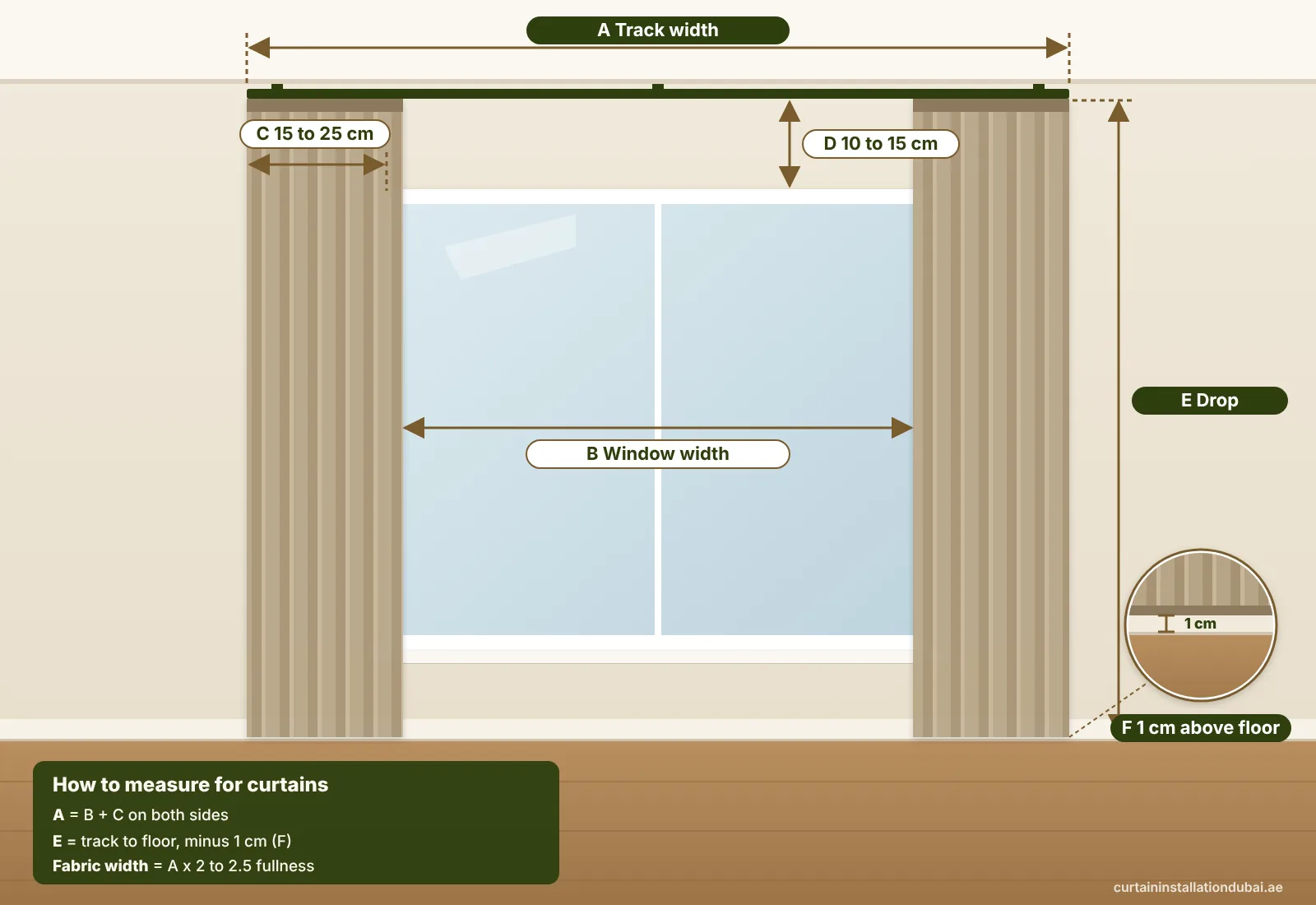
The short answer: make the track 15 to 25 cm wider than the window on each side, measure the drop from the track to 1 cm above the floor, and multiply the track width by 2 to 2.5 for the fabric. Here is how to get each number right.
What you need before you start
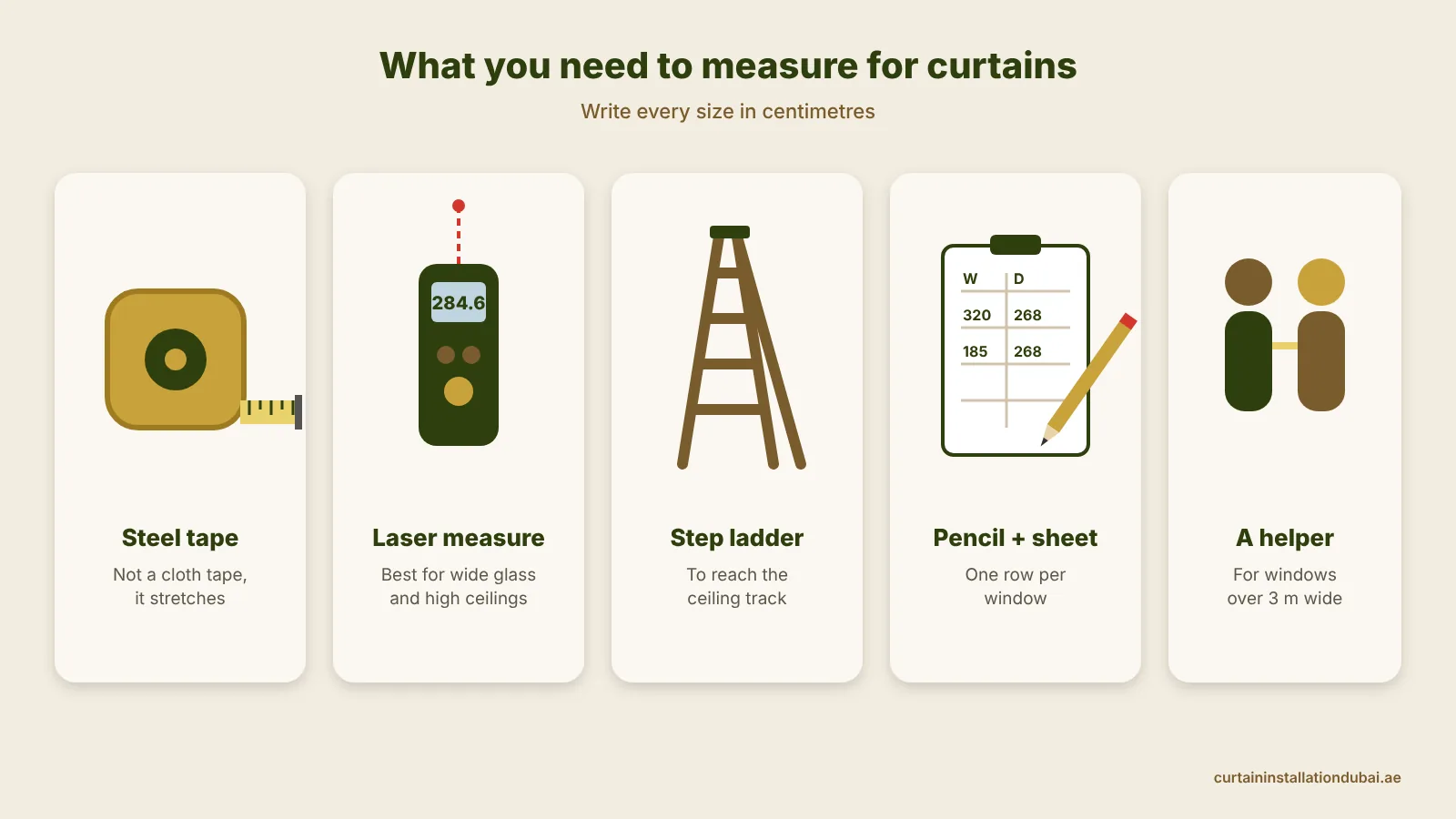
Five things, and most homes already have four of them:
- A steel tape or a laser measure. Skip the cloth sewing tape. It stretches, and over a 3 m window it can add a centimetre or two without you noticing. A laser measure is easier on wide glass and high ceilings.
- A step ladder. Most Dubai apartments use ceiling tracks, so you will be measuring from the ceiling down.
- A pencil and the worksheet below. One row per window, even if two windows look identical.
- A second person for anything wider than 3 m, to keep the far end of the tape level.
Write every size in centimetres. Curtain workshops and fabric suppliers in Dubai all work in cm, and converting from inches is where rounding mistakes start.
Decide where the curtain will hang first
Every number you take starts from the point the curtain hangs from. Settle that first, or you will end up measuring twice. If you are still deciding how high and how wide the curtain should go, read how to hang curtains properly before you measure.
Ceiling track or wall rod?
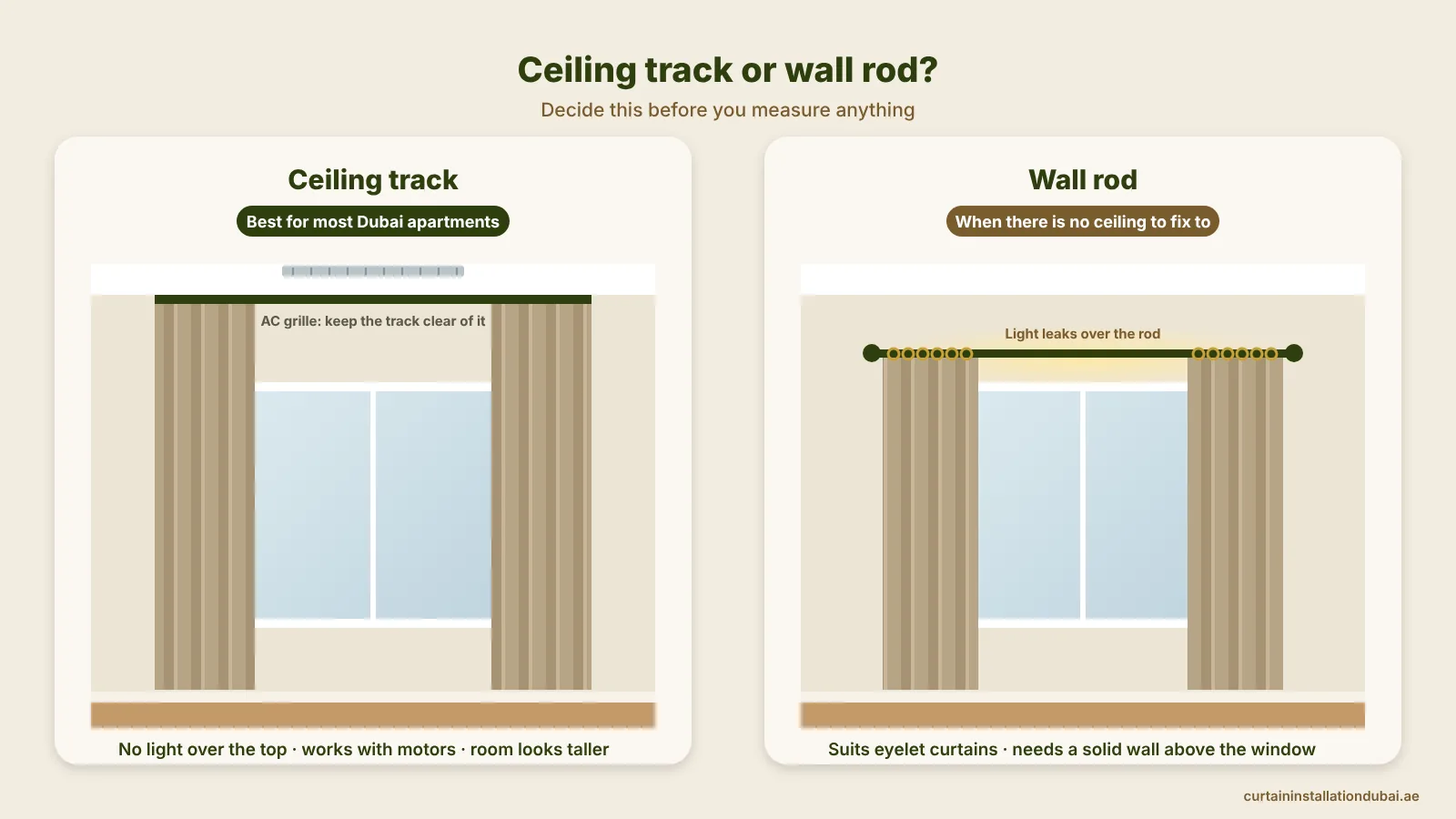
A ceiling track fixes into the ceiling or a gypsum pelmet and lets the curtain run from ceiling to floor. No light gets over the top, the room looks taller, and it is the only option if you want to add a motor later. Most Dubai apartments built in the last ten years already have a gypsum ceiling or a pelmet slot made for one.
A wall rod screws into the wall above the window. It suits eyelet curtains and older villas with no false ceiling, but you need solid wall above the frame, and some light will always show over the rod.
One thing to check before you choose: a linear AC grille near the window. Keep the track clear of it, or the curtain will sway every time the AC comes on.
Short version: if you have a ceiling or pelmet above the window, use a track. If all you have is wall, use a rod. You can compare both on our curtain rails and tracks page.
Inside the recess or outside the frame?
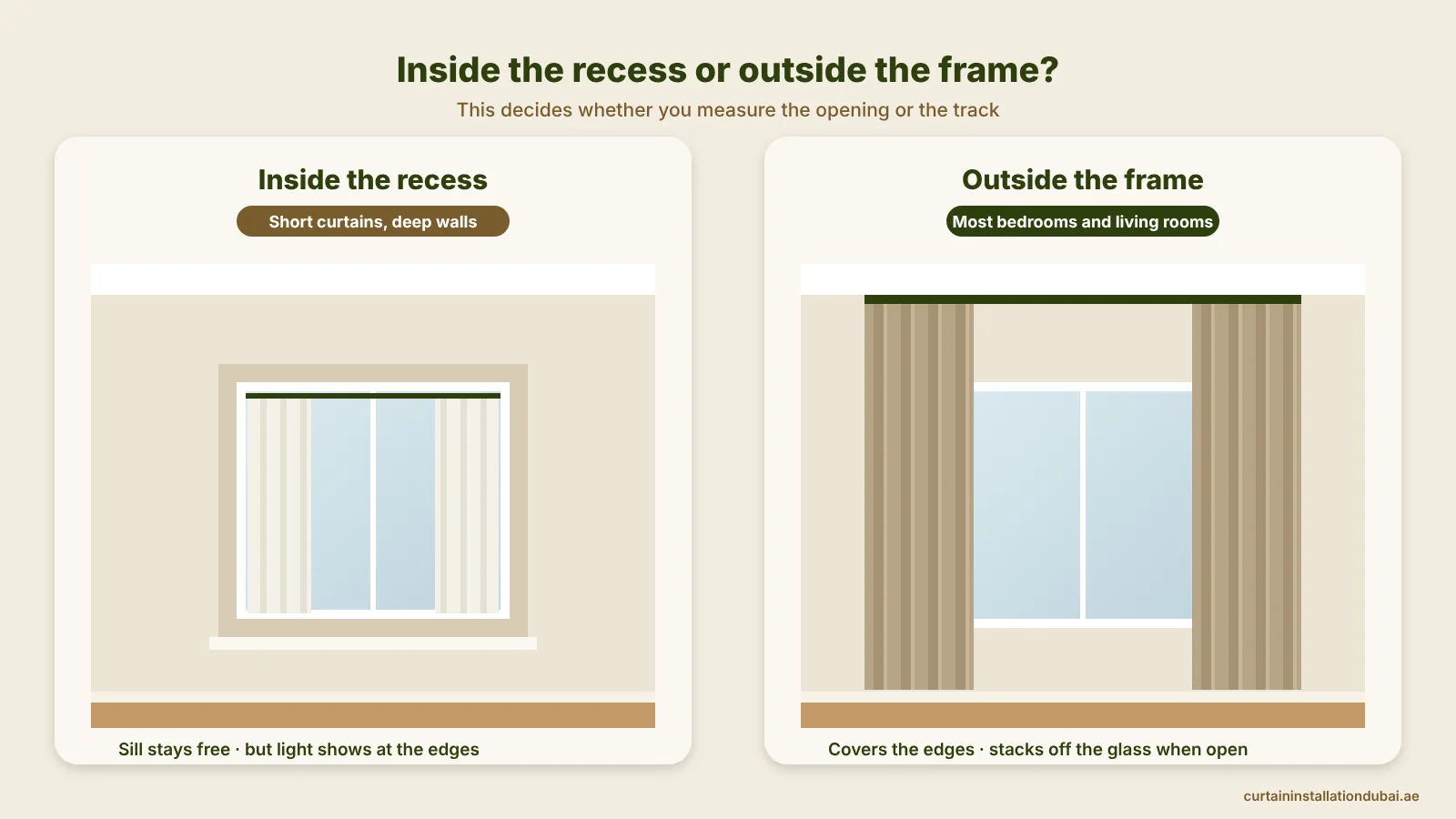
Inside the recess means the curtain hangs within the window opening. It works for deep villa walls, kitchens and bathrooms where you want the sill free. The catch is that light shows around the edges, and the curtain covers part of the glass even when it is open.
Outside the frame means the curtain covers the window and some wall on each side. This is what we fit in almost every bedroom and living room, because it blocks the edges and stacks clear of the glass.
This choice changes what you measure. Inside the recess, you measure the opening itself. Outside the frame, you measure the track. The next two steps cover both.
Step 1: Measure the width
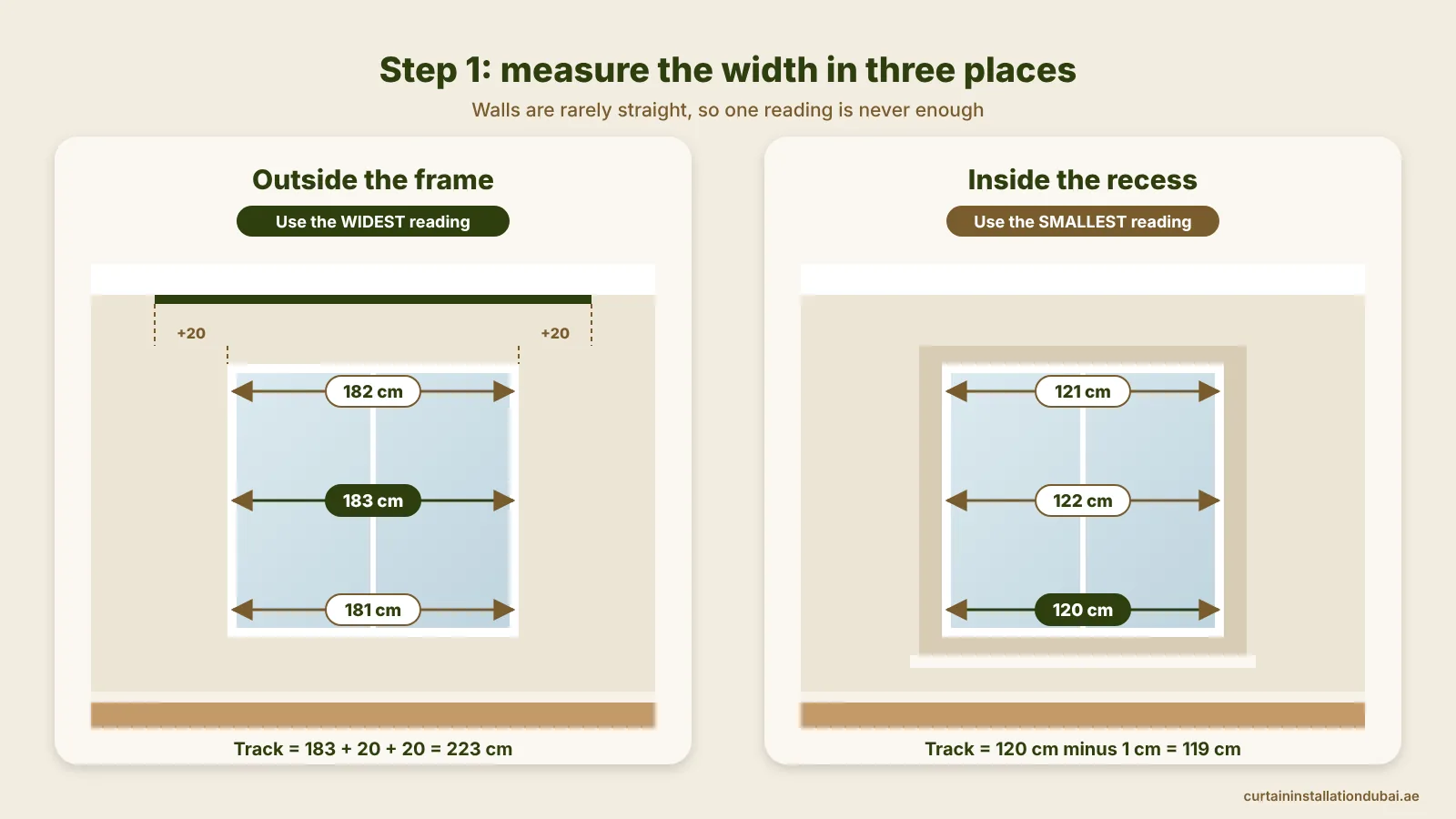
Measure the track or rod, not the glass. The track sets how wide the curtain is, and on almost every Dubai window it should be wider than the frame.
If the curtain hangs outside the frame
- Measure across the window frame at the top, the middle and the bottom.
- Take the widest of the three.
- Add 15 to 25 cm on each side. Use the higher end if there is space, because a wider track leaves more of the glass clear when the curtain is open.
A frame that reads 182, 183 and 181 cm needs a track of 183 + 20 + 20 = 223 cm.
If a track is already fitted and you are keeping it, skip all of this and measure the track itself, end bracket to end bracket.
If the curtain hangs inside the recess
- Measure the opening wall to wall at the top, middle and bottom.
- Take the smallest reading, because the track has to fit the narrowest point.
- Take off 1 cm so the track slides in without scraping the plaster.
An opening of 121, 122 and 120 cm gets a track of 119 cm.
Why three readings? Plastered walls and window frames in Dubai buildings are rarely straight. A 1 to 2 cm difference from top to bottom is normal, and one reading will not catch it.
Step 2: Measure the drop
The drop is the height of the finished curtain. Measure it from the hook point, not from the top of the track:
- Ceiling track: from the glider where the hook clips in, usually 1 to 2 cm below the track itself.
- Rod with rings: from the bottom of the ring.
- Eyelet rod: from the top of the rod. The eyelet header sits a few centimetres above it, and the workshop allows for that.
Measure down to the floor on the left, in the middle and on the right, and use the shortest reading. Many Dubai floors drop slightly towards the balcony door, and a curtain cut to the longest reading will drag at the low point.
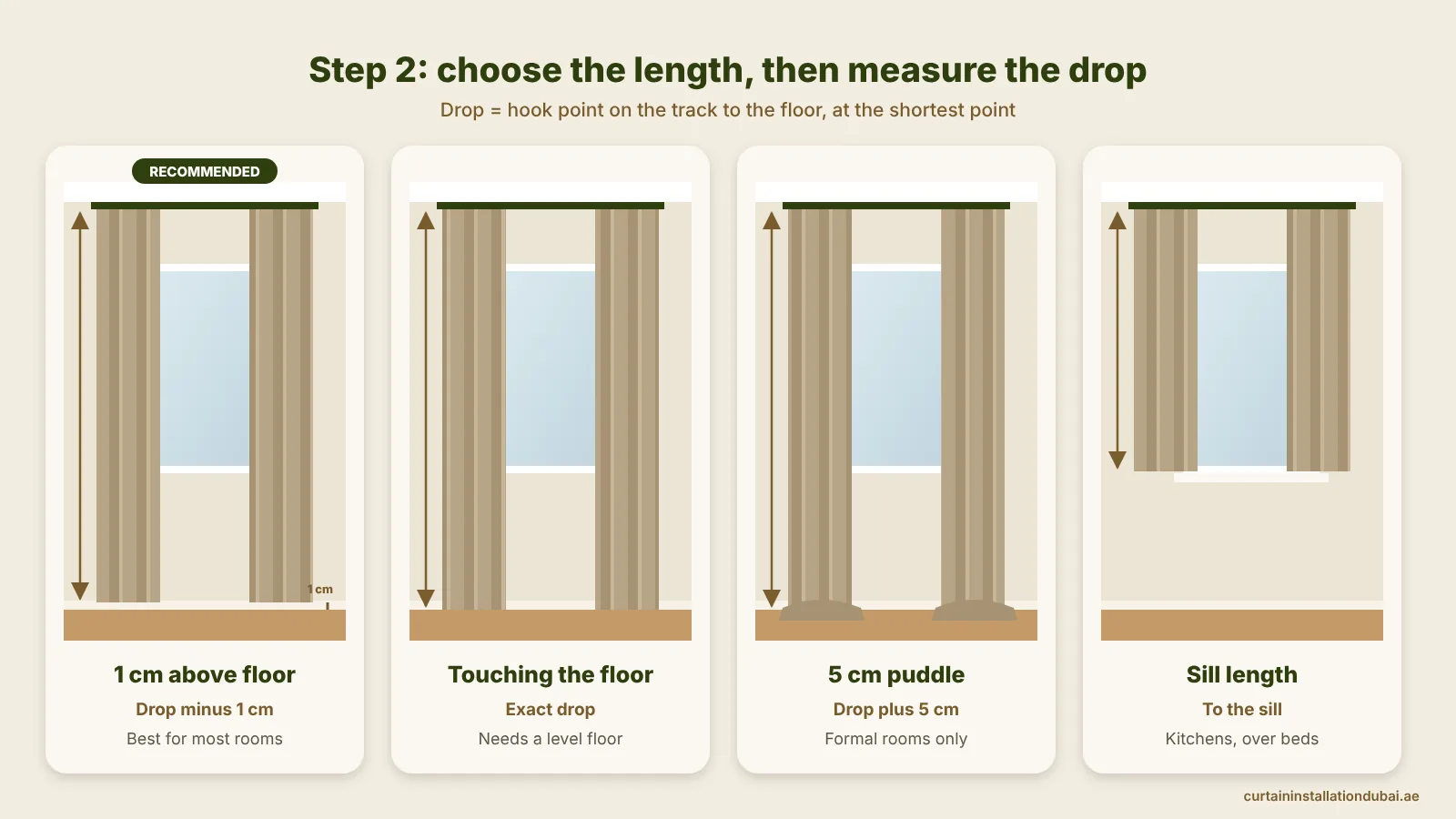
Then adjust that number for the length you want.
Which curtain length should you choose?
| Length | How to work it out | Best for | Watch out for |
|---|---|---|---|
| 1 cm above the floor | Shortest drop minus 1 cm | Bedrooms, living rooms, motorized curtains | Nothing. This is the one we fit most |
| Touching the floor | Exact shortest drop | Formal rooms with a level floor | Shows every uneven tile |
| 5 cm puddle | Drop plus 5 cm | Formal majlis and dining rooms | Collects dust; not for motors, kids or pets |
| Sill length | Hook point to 1 cm above the sill | Kitchens, bathrooms, windows over a bed or desk | Lets light in under the hem |
For bedrooms, 1 cm above the floor wins every time. It stops light at the bottom, clears the floor when you open the curtain, and keeps its line on an uneven floor. We explain it in more detail on our bedroom curtains page.
Step 3: Work out fullness (how much fabric you need)
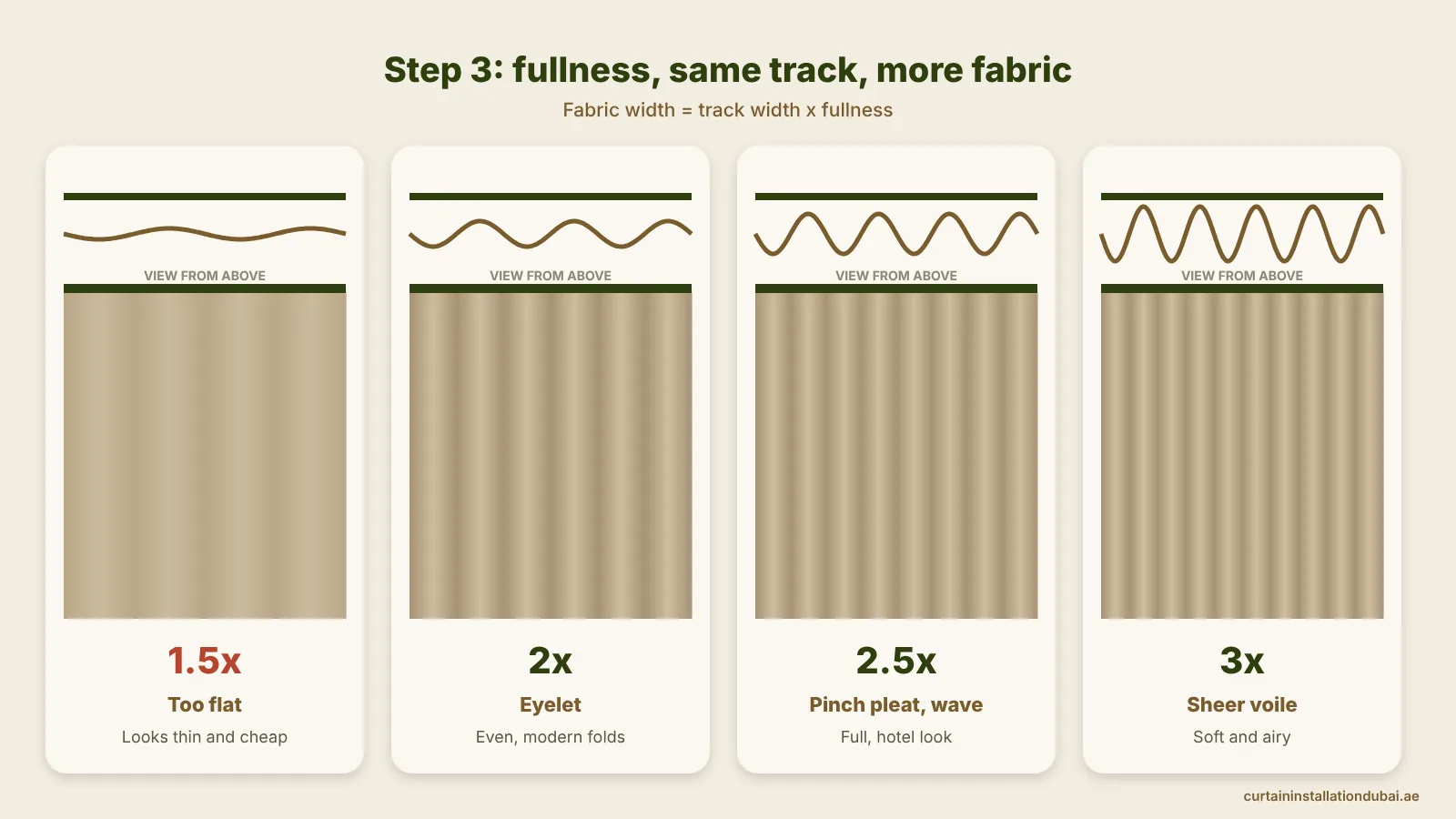
A curtain is never as wide as the track. It needs extra fabric to fall into folds, and that extra is called fullness. Too little and the curtain hangs flat, like a sheet. Too much and it bunches and will not close neatly.
Fabric width = track width x fullness
For a pair that meets in the middle, divide the result by 2 to get the width of each panel.
Take the 223 cm track from Step 1:
- Eyelet at 2x: 223 x 2 = 446 cm, so two panels of 223 cm
- Pinch pleat at 2.5x: 223 x 2.5 = 557.5 cm, so two panels of about 279 cm
How much fullness does each curtain style need?
| Curtain style | Fullness | Why |
|---|---|---|
| Eyelet | 2x | Rings set the fold depth; more fabric will not close on the rod |
| Pinch pleat, double | 2x | Clean, modern pleats |
| Pinch pleat, triple | 2.5x | Deeper columns for formal rooms |
| Wave / ripple fold | 2.5x | Needs the extra to form even S-curves |
| Sheer voile | 2.5 to 3x | Light fabric looks thin below 2.5x |
| Blackout lining behind a curtain | Same as the face fabric | Sewn in together |
Anything under 2x looks cheap, whatever the fabric costs. If the budget is tight, a lower-priced fabric at full 2x will look better than an expensive one at 1.5x.
Our quotes are priced on the size of the curtain as made, not on the fabric used, so fullness never appears as a separate line. Our curtain prices in Dubai guide shows the rate for each fabric. You do not need to work it out to compare prices.
Step 4: Allow for stack-back
Stack-back is the space a curtain takes up when it is fully open. Fabric does not disappear when you pull it aside. It folds into a bundle at each end of the track, and that bundle is wider than most people expect.
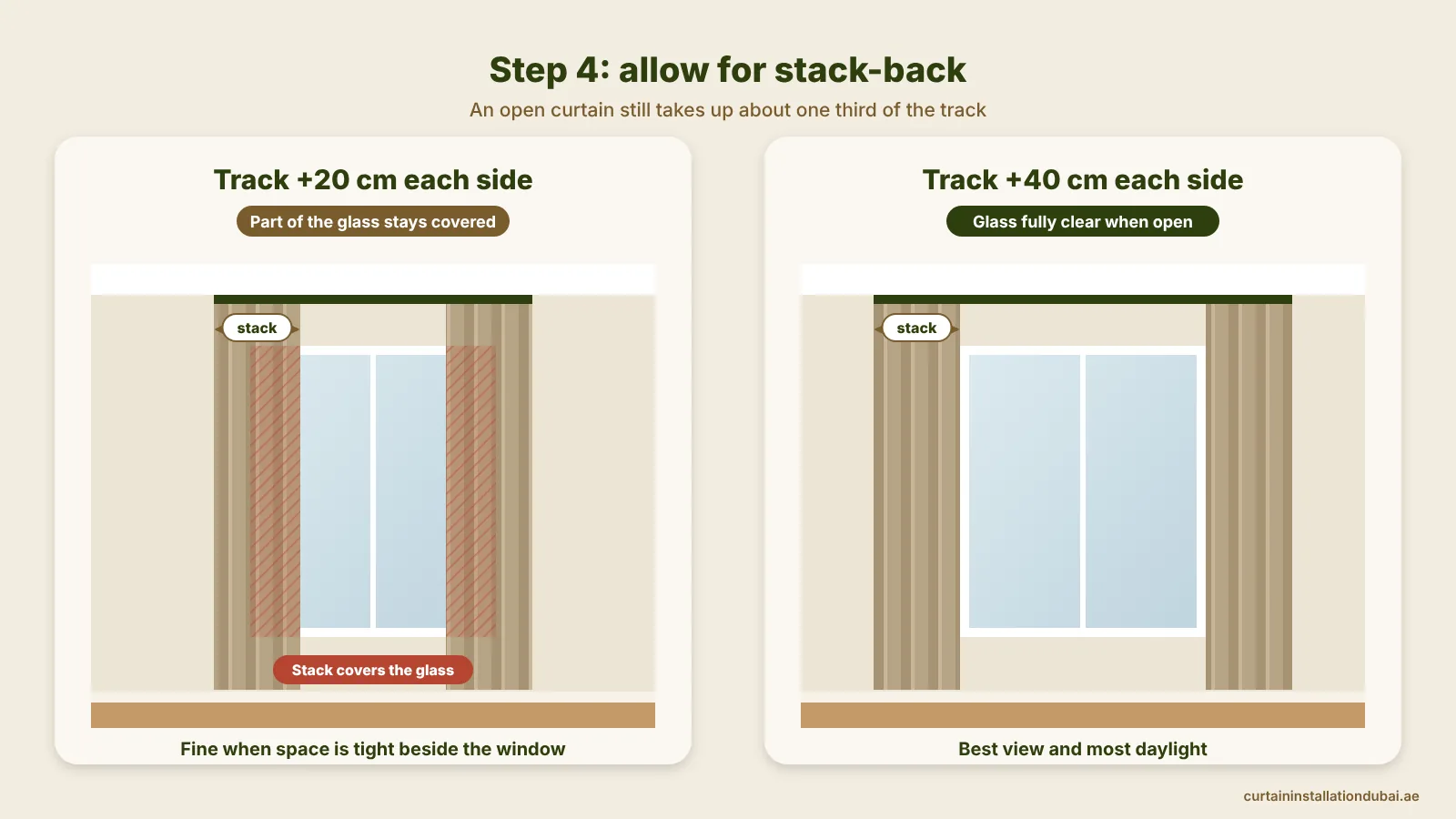
As a rough guide, an open pinch pleat curtain takes up about one third of the track width. Wave and eyelet curtains stack a little tighter, sheers tighter still.
Back to the 223 cm track from Step 1. One third is about 74 cm, so roughly 37 cm of curtain sits at each end. With only 20 cm of track past the frame, about 17 cm of each stack still hangs over the glass.
You have two choices:
- Accept it. If the wall beside the window is short (a corner, a wardrobe, a door), a little curtain over the glass is fine.
- Clear the glass completely. Extend the track by half the stack on each side. For a 183 cm window that means about 45 cm a side, so a track of roughly 275 cm. A quick rule: a track 1.5 times the window width clears the glass for pinch pleat curtains.
Clearing the glass gives you the full view and all the daylight, and it makes the window look wider than it is. It is the one change that makes a cheap curtain look expensive.
How to measure Dubai’s tricky windows
Most guides stop at a single window with wall on both sides. Plenty of Dubai homes do not have one.
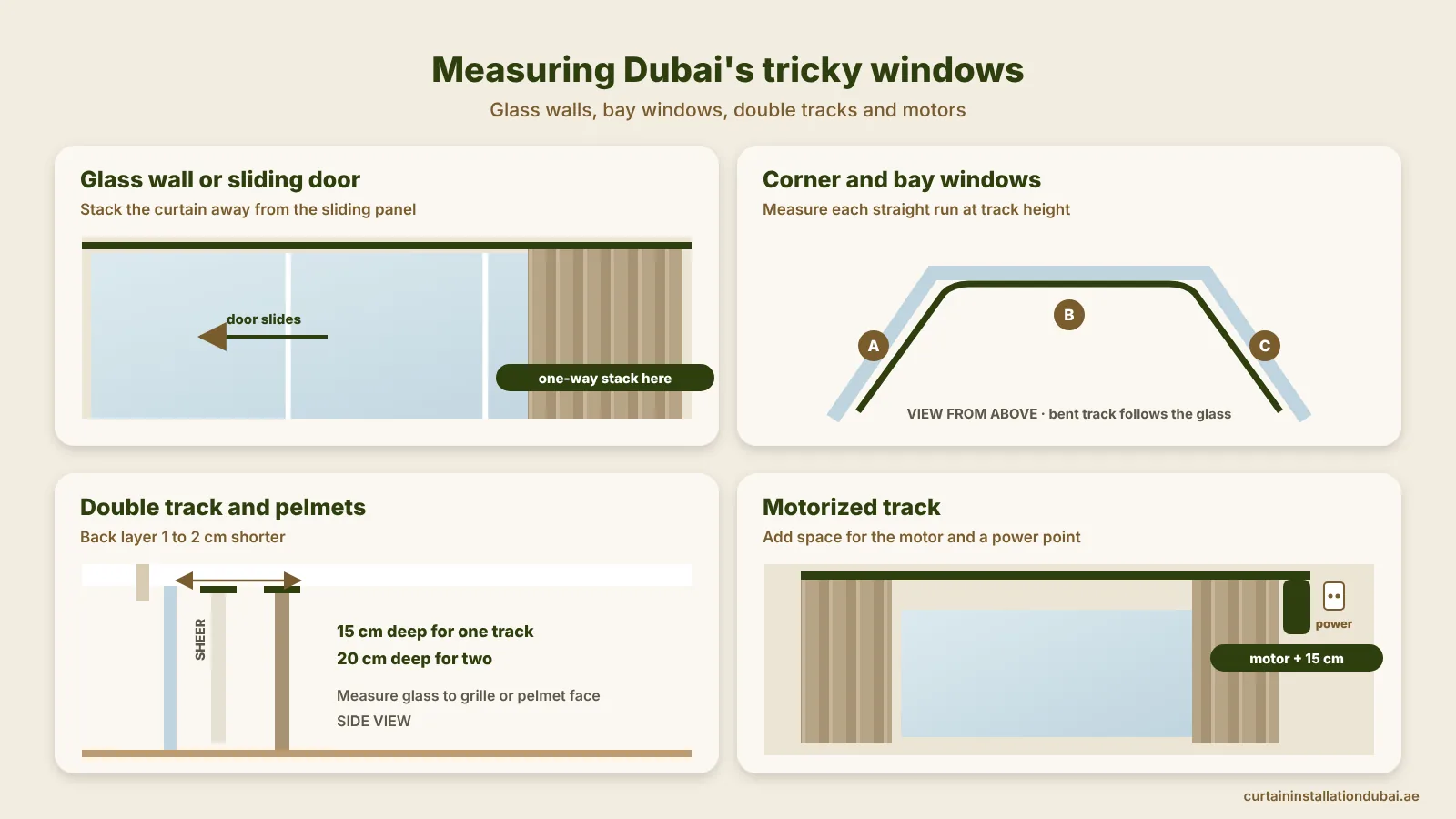
Floor-to-ceiling glass walls and sliding doors
Measure wall to wall at track height, then take 1 cm off each end. Measure the drop at both ends and in the middle, because ceilings that run 3 m or more often dip.
On a sliding door, decide which way the curtain should open before you order. It needs to stack on the fixed panel, not the sliding one, or you will be pushing fabric aside every time you go out to the balcony. A single panel that opens to one side is often the cleaner answer.
Corner and bay windows
A bay needs a bent track that follows the glass. Measure each straight run separately at track height (A, B and C in the diagram) and note roughly how sharp each angle is. A paper template of the corner helps. Getting the bends right is the hardest part of any curtain job, so this is the one we usually measure ourselves.
Windows with an AC grille or a pelmet above
Measure the depth from the glass to the face of the grille or pelmet. A single track needs about 15 cm of clear depth for the curtain to move freely, and a double track needs about 20 cm. If you have less, the curtain will rub the glass or catch on the grille.
Double track (sheer + blackout)
Measure each track on its own, because a pelmet is not always square. Make the back layer, usually the sheer, 1 to 2 cm shorter than the front blackout, so it never peeks out under the hem.
Motorized track
The motor sits at one end of the track and takes about 15 cm. The curtain cannot stack under it, so add that to the track length. You also need a power point within reach of the motor end, or a battery motor. Our motorized curtains page explains the options.
Worked example: a 3 m bedroom window, measured and priced
Here is one window from start to finish: a master bedroom in a Dubai Marina apartment, with a ceiling track and blackout curtains so the room goes dark.
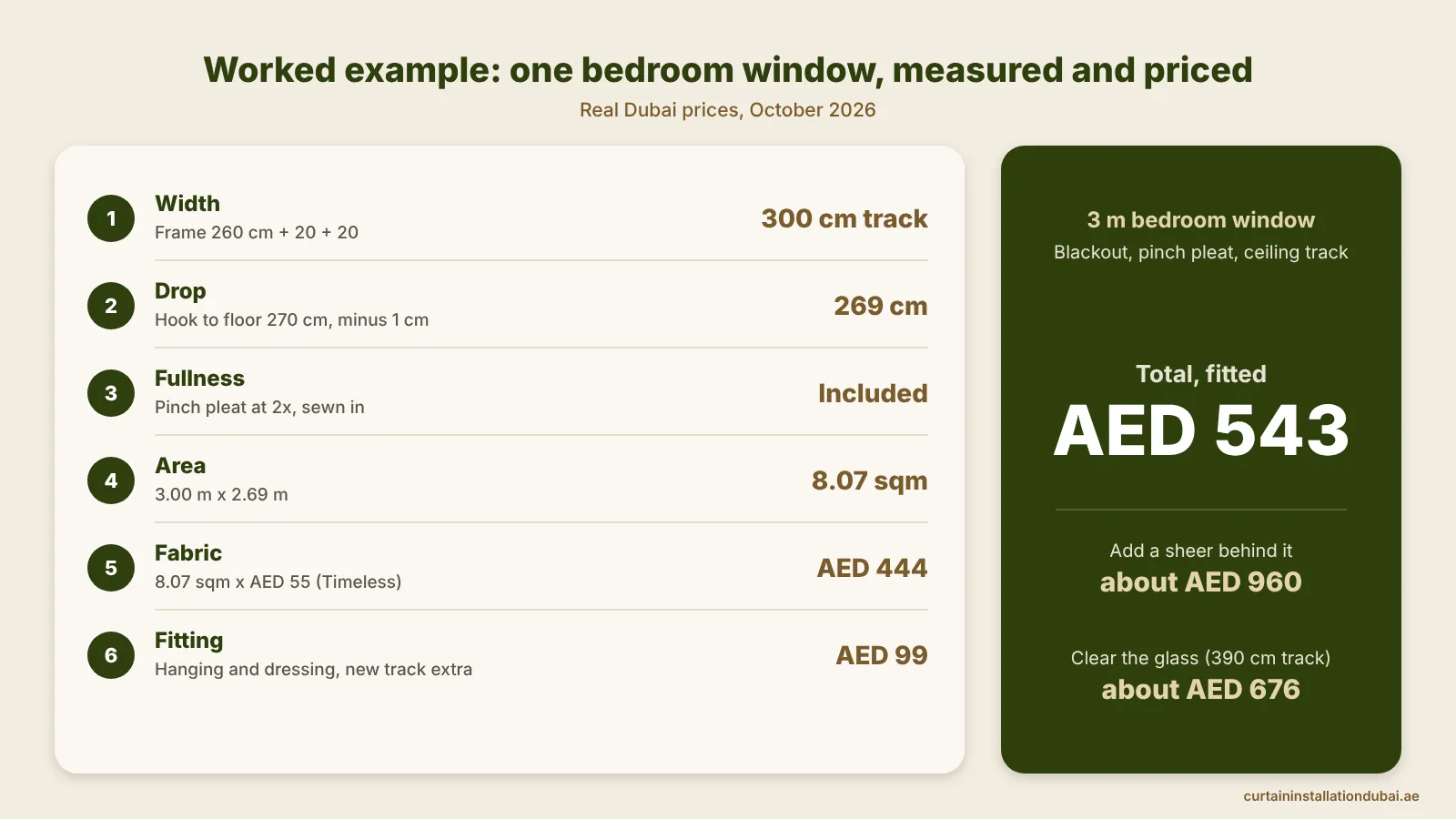
- Width. The frame measures 259, 260 and 258 cm. Take the widest, 260 cm, and add 20 cm each side. Track: 300 cm.
- Drop. Hook point to floor reads 271, 270 and 270 cm. Take the shortest, 270 cm, and take off 1 cm so the hem clears the floor. Drop: 269 cm.
- Fullness. Pinch pleat at 2x. There is no extra charge for it: the quote is based on the finished curtain size, which already allows for the gathering.
- Area. 3.00 m x 2.69 m = 8.07 sqm.
- Price. Our Timeless blackout at AED 55 per sqm comes to AED 444. Add AED 99 fitting and the window costs about AED 543.
Two common changes, priced the same way:
- Add a sheer behind it on a double track. Sheer from AED 45 per sqm plus AED 150 fitting for both layers comes to about AED 960.
- Clear the glass completely with a 390 cm track (Step 4). That is 10.5 sqm of curtain, about AED 676.
A new track is extra if you do not have one. Our free measuring visit gives you a fixed price for every window before anything is made.
Curtain size chart
Bookmark this one. Find your window width on the left and read across. Every size assumes the curtain hangs outside the frame with 20 cm of track on each side, and a pair of panels meeting in the middle.
| Window width | Track width | Fabric at 2x | Each panel at 2x | Fabric at 2.5x | Each panel at 2.5x |
|---|---|---|---|---|---|
| 100 cm | 140 cm | 280 cm | 140 cm | 350 cm | 175 cm |
| 150 cm | 190 cm | 380 cm | 190 cm | 475 cm | 237 cm |
| 200 cm | 240 cm | 480 cm | 240 cm | 600 cm | 300 cm |
| 250 cm | 290 cm | 580 cm | 290 cm | 725 cm | 362 cm |
| 300 cm | 340 cm | 680 cm | 340 cm | 850 cm | 425 cm |
| 350 cm | 390 cm | 780 cm | 390 cm | 975 cm | 487 cm |
| 400 cm | 440 cm | 880 cm | 440 cm | 1,100 cm | 550 cm |
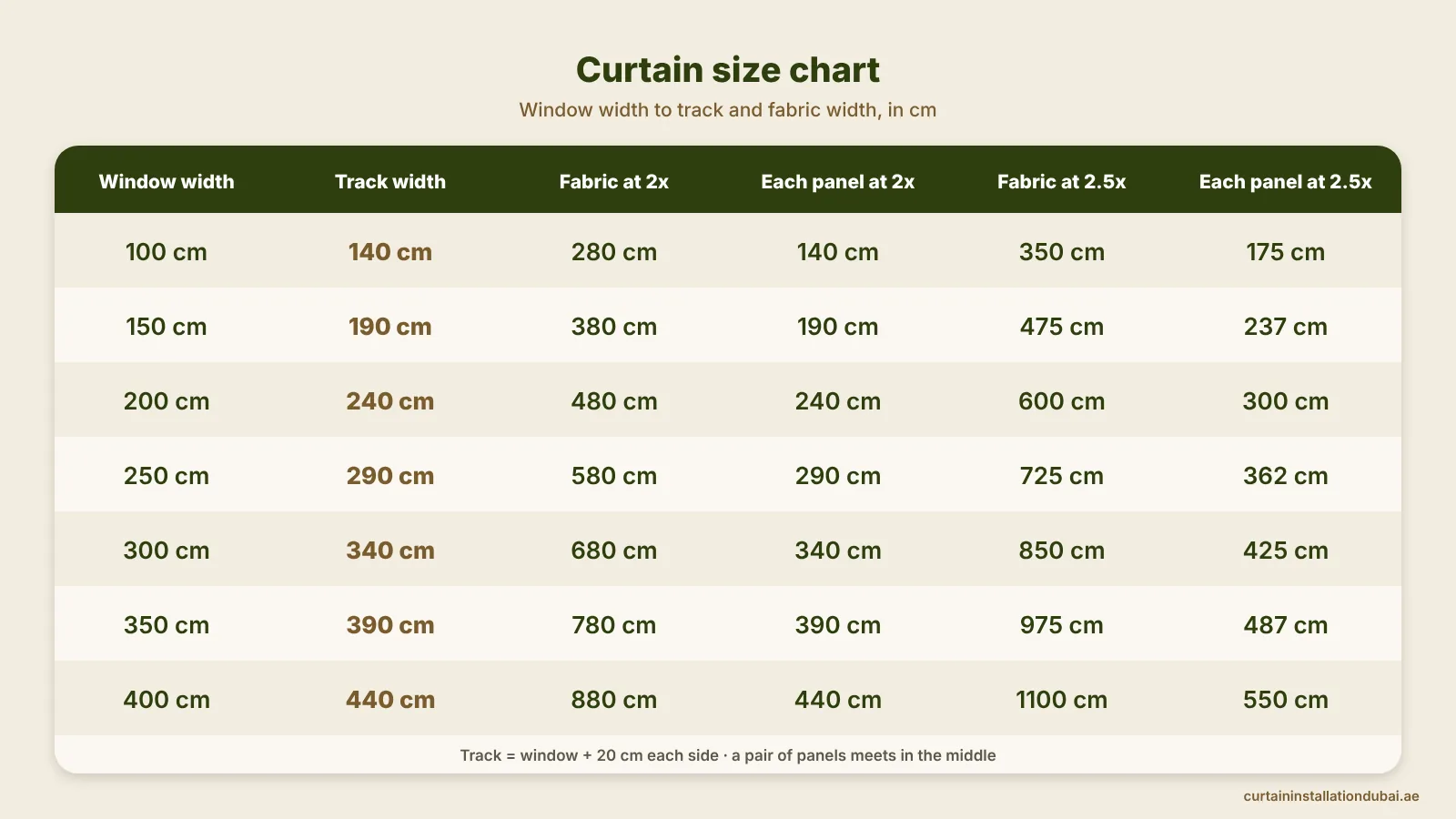
Typical drops in Dubai apartments. Most ceilings are 260 to 300 cm. With a ceiling track and a hem 1 cm above the floor, the drop is usually about 3 cm less than the ceiling height. A 270 cm ceiling gives a drop of roughly 267 cm. Always measure your own room, though, because every room is different.
Download the measuring worksheet
Print it, fill in one row per window, then send a photo to us on WhatsApp and we will price every window from it. The sheet has spaces for three width readings, three drop readings, the length style, the curtain style and notes on AC grilles, pelmets or motors.
Download the curtain measuring worksheet (PDF)
6 measuring mistakes that cost the most
A curtain cannot be stretched once it is sewn, and cutting it down is not much better. A wrong measurement usually means a remake, and a remake costs as much as the curtain did.
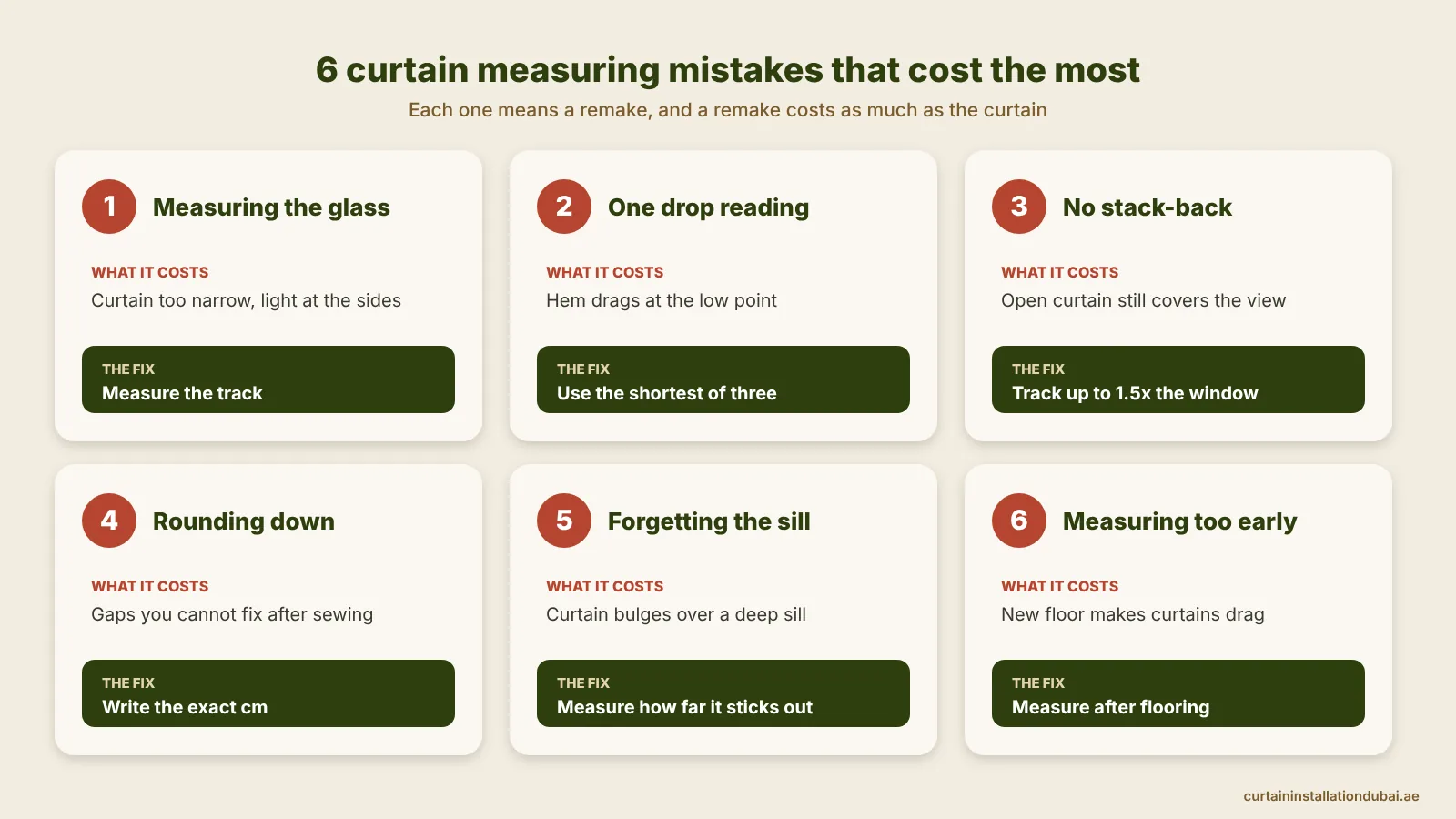
- Measuring the glass instead of the track. The curtain ends up exactly window-width, and light pours in at both sides. See Step 1.
- Taking one drop reading. The hem drags on the floor where it dips and floats where it rises. See Step 2.
- Forgetting the stack-back. The curtain is open but still covers a third of the view. See Step 4.
- Rounding down. 268.5 cm written as 268 cm sounds harmless. Do it on the width and the drop, across a pair of panels, and you end up with a gap in the middle and a hem that clears the floor by 2 cm instead of 1. Write the exact number, half centimetres included, and let the workshop do the rounding.
- Ignoring the sill. A deep marble sill, common in Dubai villas, can stick out 5 to 8 cm past the wall. A floor-length curtain has to hang in front of it, so the track must sit far enough from the wall to clear it, or the fabric bulges over the edge. Measure how far the sill sticks out and write it in the notes column of the worksheet.
- Measuring before the flooring goes in. On a new handover or renovation, tiles, parquet or carpet can raise the floor by 1 to 3 cm. Curtains measured on bare screed will drag once the floor is laid. Wait until the final floor is down, or ask us to measure after the fit-out.
Measure it yourself or book a free visit?
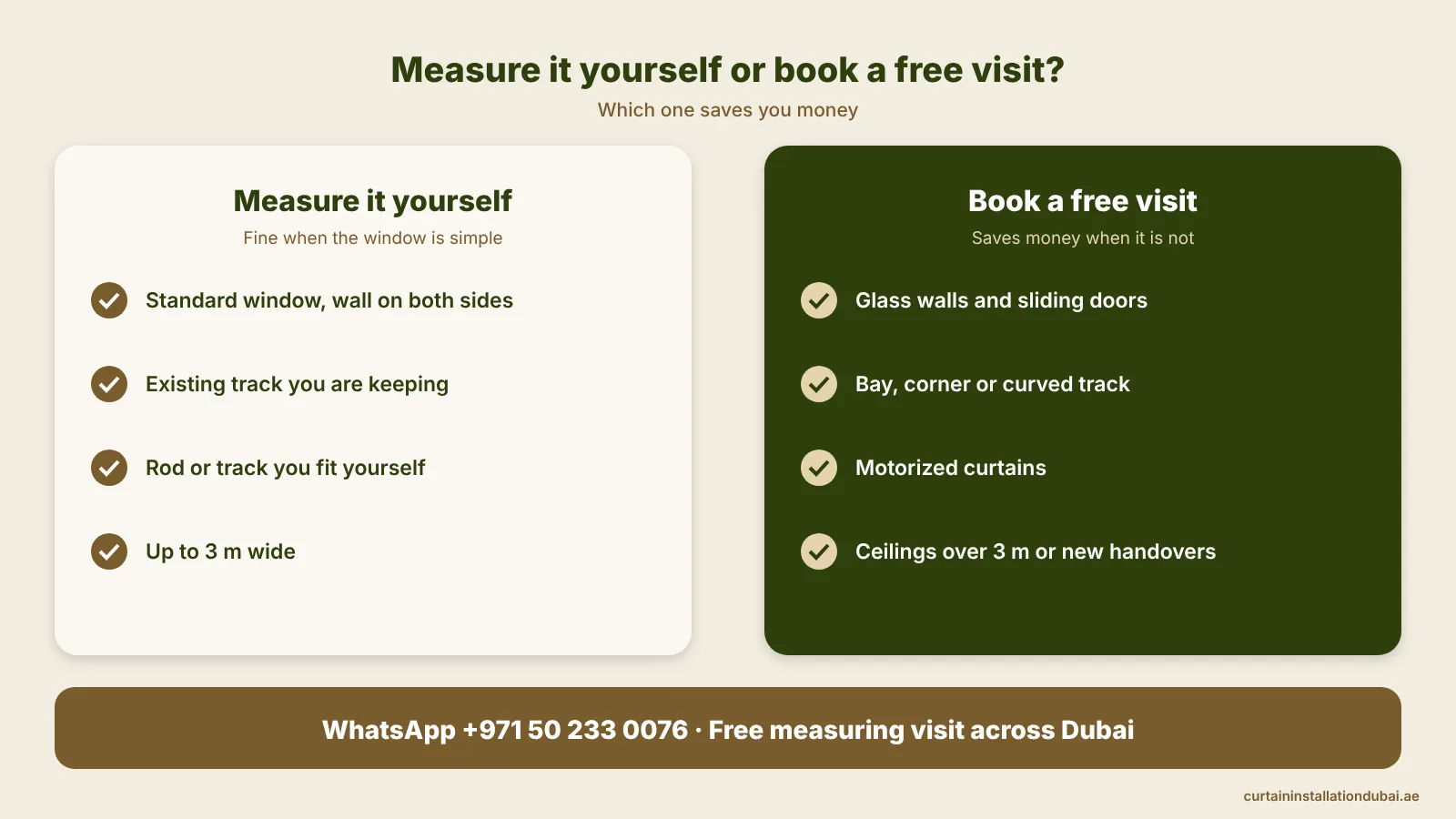
You can measure most windows yourself with this guide. It is fine on your own when the window has wall on both sides and nothing awkward above it, you are keeping a track that is already fitted, or the window is under 3 m wide.
Book a visit when a mistake would cost more than the visit saves. That means glass walls and sliding doors, bay or corner windows, motorized tracks, ceilings over 3 m, and new handovers where the flooring is still going in. These are the jobs where a few centimetres decide whether the curtain works, and where a remake costs the most.
Our visit is free, anywhere in Dubai, and usually the same day or the next. We bring fabric samples, measure every window with a laser, check the ceiling or pelmet for fixing, and give you one fixed price before anything is cut. If you would rather measure yourself, fill in the worksheet and send it to us on WhatsApp. We will check your numbers and price them for free.
Curtain measuring FAQs
How many curtain panels do I need for one window?
Most windows take a pair, two panels that meet in the middle. A window under about 1 m, or one beside a wall where the curtain can only open one way, works with a single panel. On glass walls wider than about 4 m we usually make four panels, because each one is easier to draw and to take down for cleaning.
Should I give you the window size or the finished curtain size?
Give us the track width and the drop, measured the way this guide explains. We work out the fullness, the header and the hems from those two numbers. Ordering a finished size from a shop catalogue is how most people end up with curtains that are too narrow.
How do I measure around a wall-mounted split AC?
Measure from the bottom of the AC unit to the top of the window frame. You need at least 10 cm of clear space for the track and the curtain header. With less than that, either hang the track below the AC or ask us about a ceiling track placed in front of it, so the airflow does not blow the curtain about.
Can I reuse my old curtains on a new track?
Often, yes. Measure each panel’s finished width and drop, and note where the hooks sit. If the panels are too short or the header does not suit the new track, our curtain alteration team can re-hem, re-tape or re-pleat them for much less than new curtains.
Do curtains shrink after washing? Should I add extra length?
Polyester blackouts and sheers hardly shrink. Linen and cotton can lose 2 to 3% in a hot wash, which on a 270 cm drop is up to 8 cm. Do not add length to allow for it. Dry clean natural fabrics or use our curtain cleaning service, and the size you measured stays the size you get.
How long after measuring will my curtains be ready?
Usually 3 to 5 working days after you approve the fabric and the measurements, then we fit them on a day that suits you. Motorized tracks and bent bay tracks can take a few days longer.
Related services and guides
Rather we measured it for you?
Free measuring visit anywhere in Dubai, fabric samples included, and one fixed price before anything is made.