
How to Hang Curtains Properly: Height, Width and Rod Placement Guide
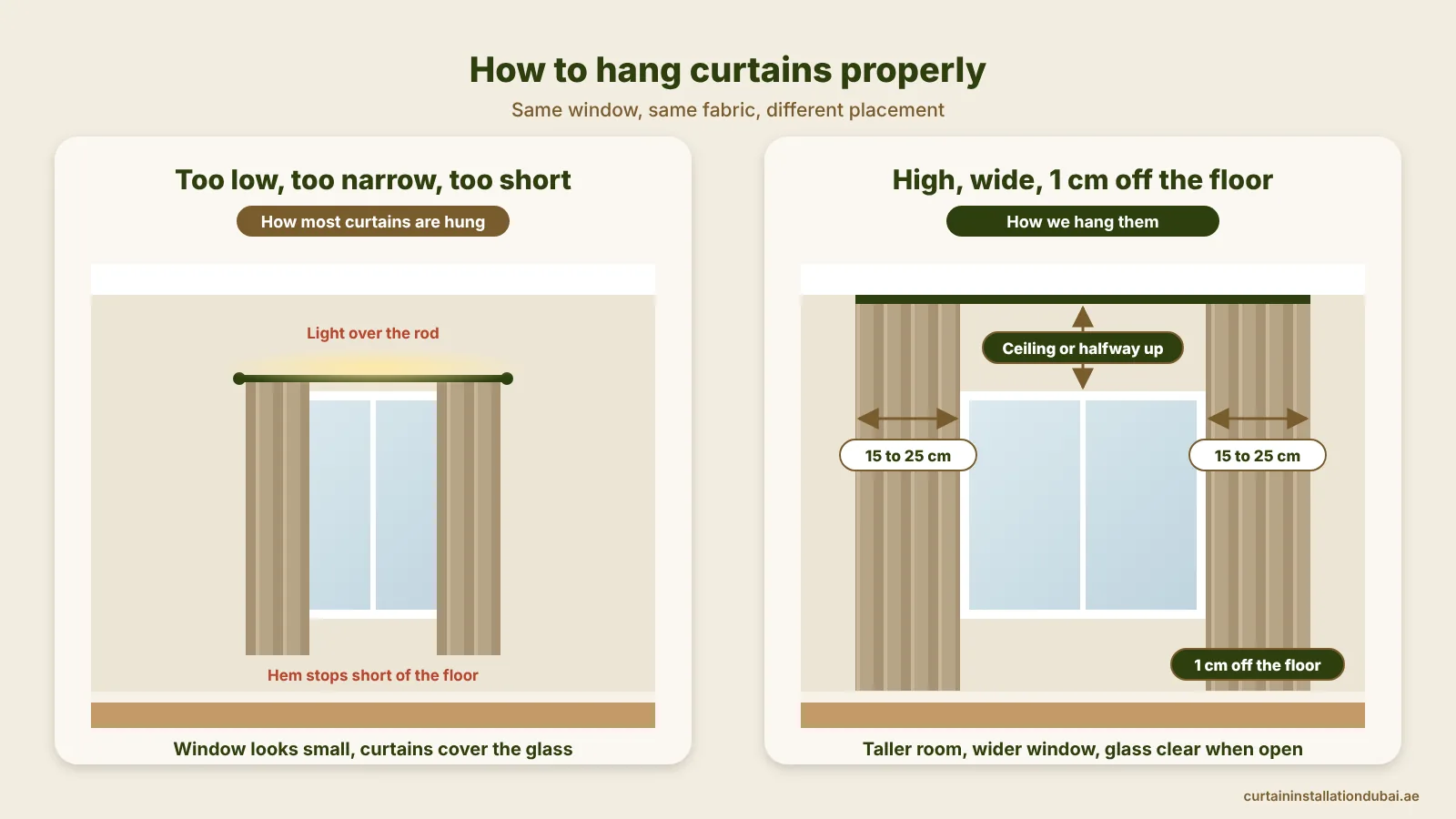
Two rooms can have the same window and the same fabric, and one still looks cramped. The difference is almost always where the curtain hangs.
Hang the rod 10 to 15 cm above the window frame, or halfway between the frame and the ceiling. In most Dubai apartments, go all the way up with a ceiling track. Run it 15 to 25 cm past each side of the window, and let the hem stop 1 cm above the floor. The sections below explain each rule, and when to break it.
The 3 placement rules at a glance
Get these three right and the curtain looks made for the room, whatever the fabric cost.
| Rule | Where | Why it matters | When to break it |
|---|---|---|---|
| Height | 10 to 15 cm above the frame, halfway to the ceiling, or on a ceiling track | A higher line makes the ceiling look taller and stops light over the top | Low ceilings under 2.6 m: always go to the ceiling. See height |
| Width | 15 to 25 cm past each side of the window | The open curtain sits on the wall, not the glass, so the window looks wider | A window tight to a corner or wardrobe: draw it one way. See width |
| Hem | 1 cm above the floor | Looks tailored, clears the floor when you open it, and stops light at the bottom | Kitchens, bathrooms and windows over a bed: sill length. See hem |
One rule ties them together: place the curtain for the wall, not the window. The window is only the starting point. The ceiling height, the space on each side and the floor decide where the curtain should actually go.
How high to hang curtains
Height changes the room more than any other choice. Each step up adds visual height to the ceiling, and each step down takes it away.
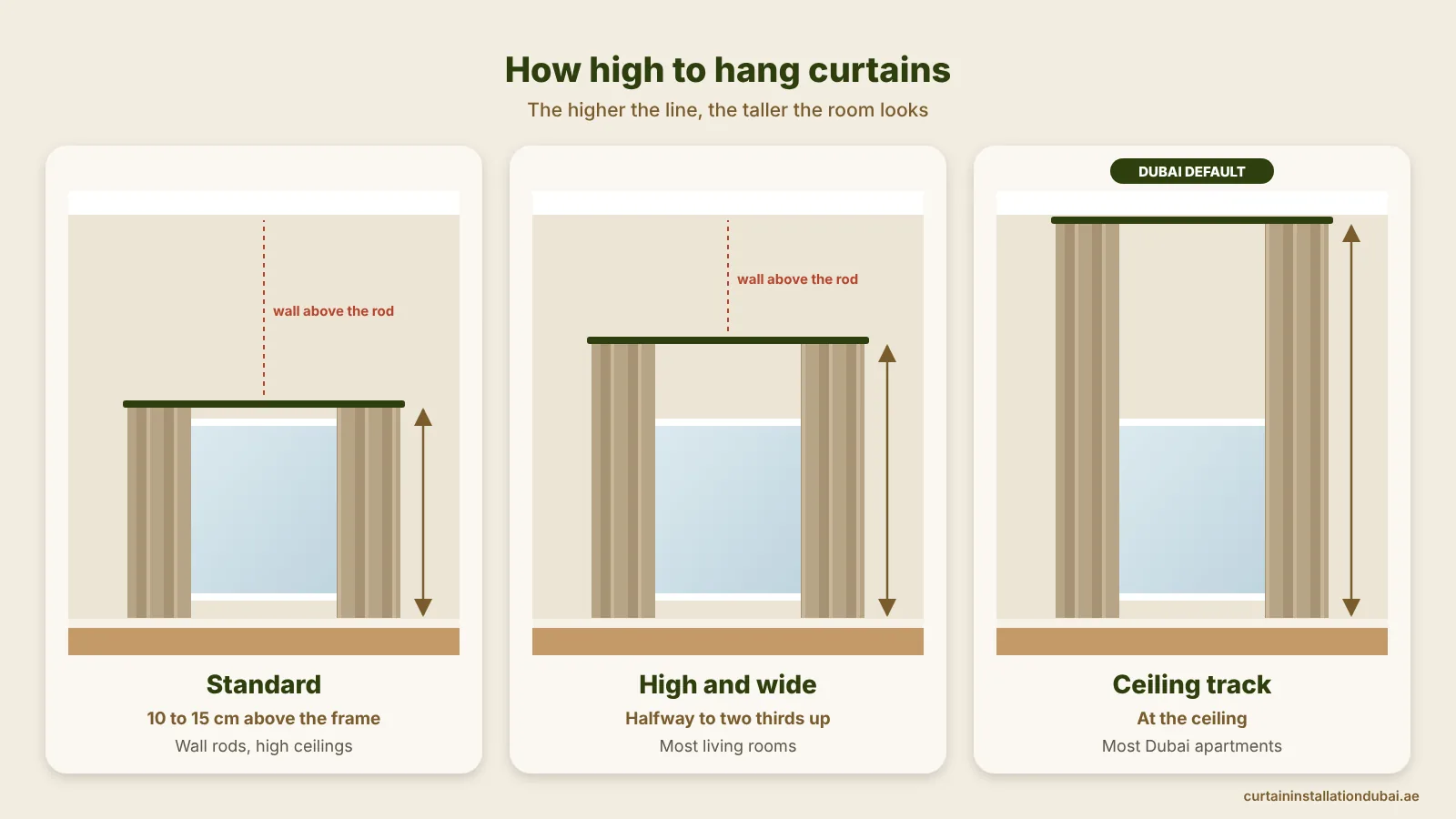
Standard, 10 to 15 cm above the frame
This is the minimum for a wall rod. It leaves room for the brackets and stops the rod from looking stuck to the window. It suits rooms with ceilings over 3 m, where going higher would leave a very long curtain hanging over a lot of bare wall. Below 10 cm the curtain looks like an afterthought, and light spills over the top.
High and wide, halfway to two thirds of the way to the ceiling
Measure the gap between the top of the frame and the ceiling, then fix the rod half to two thirds of the way up. On a 2.8 m wall with the window top at 2.2 m, that puts the rod at about 2.5 to 2.6 m. The eye follows the curtain up, the window reads taller, and the room feels bigger. This is the safe choice for living rooms with a wall rod.
Ceiling-mounted, the Dubai default
Most apartments and villas built here in the last decade have a gypsum false ceiling, so the track fixes straight into it. The curtain runs from ceiling to floor with no wall above it and no gap for light. It is the highest line you can get, and it is what we fit in most bedrooms. Ceiling tracks are also the only option for motorized curtains.
Low ceilings under 2.6 m
Always go to the ceiling. A rod even 20 cm below a low ceiling cuts the wall into two short strips and makes the room feel lower. Keep the curtain close to the wall colour and use a wave header, whose soft vertical folds pull the eye up. Skip heavy pelmet boxes, because they eat into the height you are trying to show off.
Windows with a gypsum pelmet or cornice
Many Dubai living rooms have a recessed pelmet or an LED cove built into the ceiling. Fix the track inside the recess so the header is hidden and the curtain looks as if it falls straight out of the ceiling. With an LED cove, keep the track behind the light strip so the fabric is washed with light at night. With a decorative cornice, fix the track just below it, never across it. For the depth a pelmet needs, see Dubai’s tricky windows in our curtain measuring guide.
How wide to hang them
How far the track runs past the window is covered in our curtain measuring guide. This section is about the decisions that come after the numbers: where the track sits on the wall, and when to ignore the window altogether.
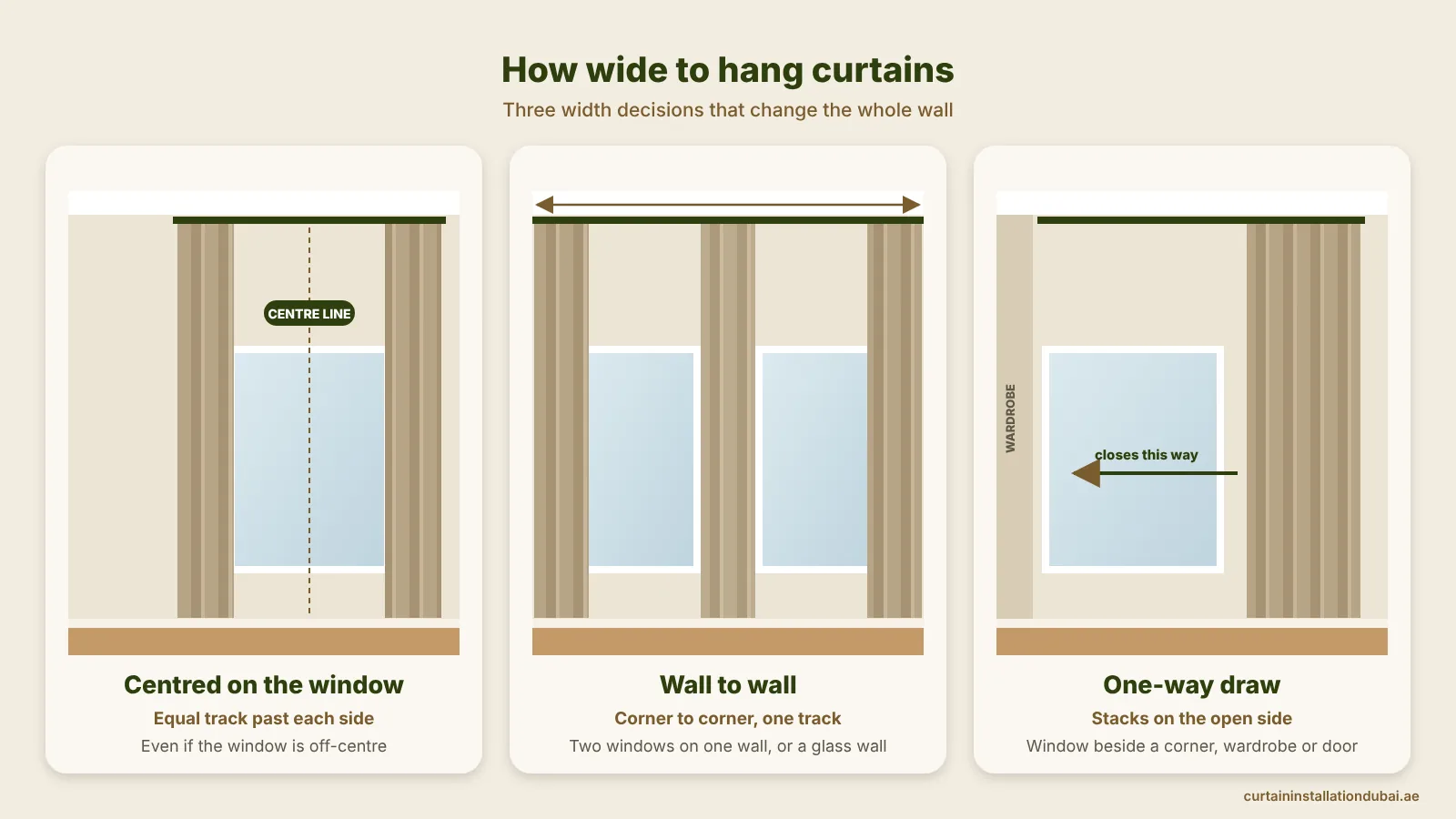
Centre the rod on the window, not the wall
Many Dubai windows sit off-centre, closer to one corner than the other. It is tempting to centre the track on the wall instead, but then one curtain covers more glass than the other and the window looks lopsided. Centre the track on the window, with the same overhang on both sides. If the wall looks unbalanced, fix it with furniture or a lamp, not the curtain.
When to go wall to wall
Run one track from corner to corner when:
- there are two or more windows on the same wall, so they read as one wide window
- the wall is mostly glass, like a balcony door next to a window
- the gap between the window and the corner is under about 40 cm, where a short stub of wall looks odd
Wall-to-wall curtains also hide uneven frames, AC pipes and switches beside the window. In bedrooms they give the darkest result, because there are no edges for light to creep around.
A window near a corner, wardrobe or door: one-way draw
When one side of the window has no room, because it sits against a corner, a built-in wardrobe or a door frame, use a single panel that opens to the side with space. Run the track right to the edge on the tight side, and let the whole curtain stack on the open side. It looks deliberate, and you get the full view when it is open. The same trick works for sliding balcony doors, with the stack on the fixed pane.
Getting the hem line right after hanging
Choosing the length happens before the curtain is made. Our curtain measuring guide covers that. Once it is up, three small checks make the difference between “nearly right” and tailored.
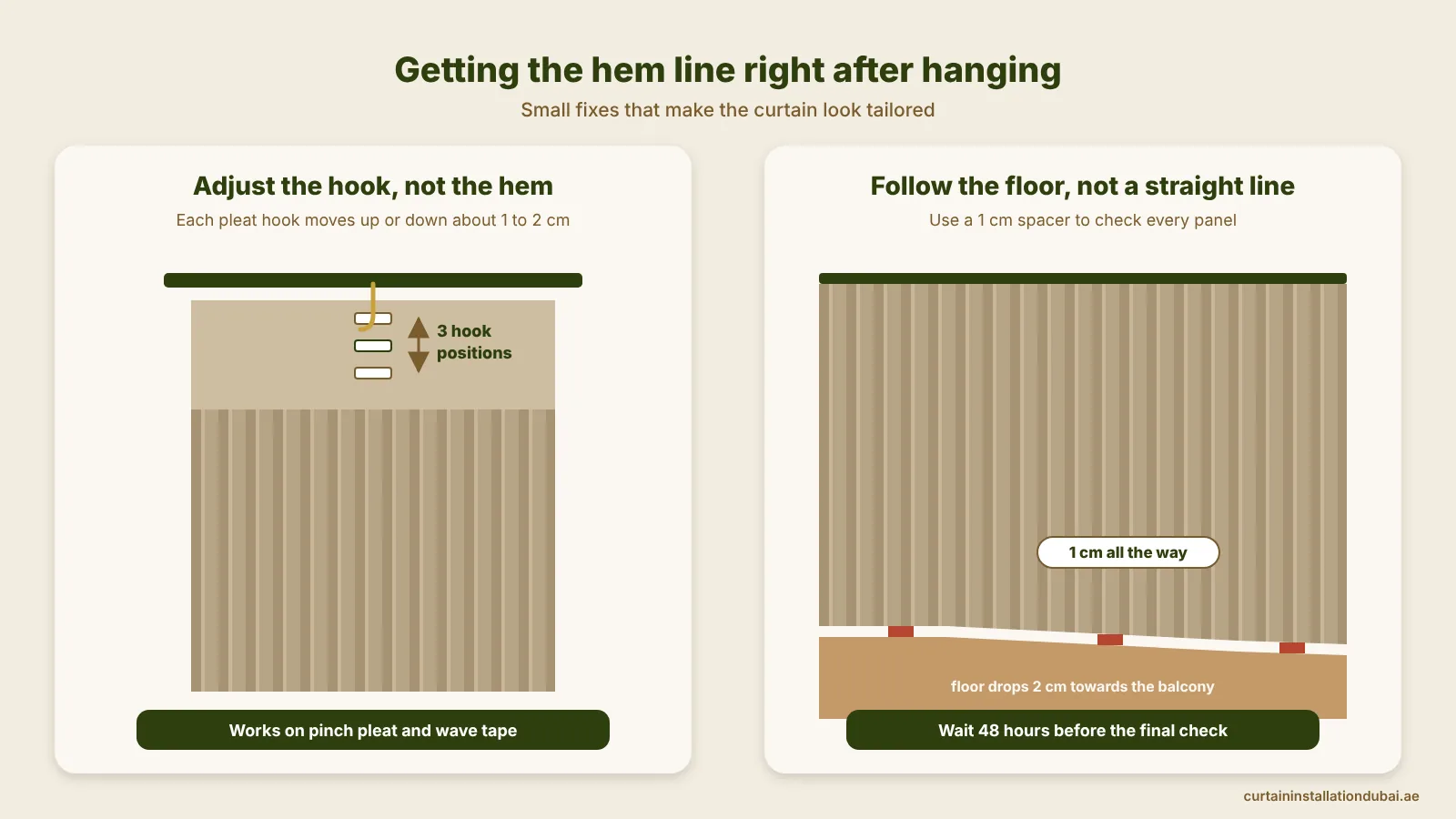
Let the fabric settle first
New curtains drop after hanging. Linen and sheers can grow by up to 1 cm in the first two days as the fibres relax, and heavy blackouts settle as the folds form. Do the final hem check after about 48 hours, not on fitting day.
Check the hem against the floor, not a straight line
Dubai floors are rarely perfectly level, especially near balcony doors. Slide a 1 cm spacer, such as a folded card or a tile spacer, under the hem at each end and in the middle of every panel. The hem should just touch it everywhere. If one end is 2 cm off the floor and the other drags, the hem is not wrong. It is following a straight line while the floor slopes.
Fine-tune with the hooks
Pinch pleat and wave curtains have header tape with several hook positions:
- Hook in a higher pocket: the curtain hangs lower.
- Hook in a lower pocket: the curtain lifts.
Each pocket moves the hem about 1 to 2 cm, enough to follow a sloping floor panel by panel. Move the hooks along one panel gradually rather than in one jump, so the header line stays smooth.
Eyelet curtains have no hooks to adjust, so small corrections come from raising or lowering the rod brackets. Anything more than 2 cm off needs a re-hem. Our curtain alteration team can lift or let down a hem without taking the curtain apart.
How to hang the curtain, step by step
This is the part most people rush, and it is where a good curtain starts to look cheap. It assumes the track or rod is already up. If it is not, our guide on how to install curtain rods on Dubai walls and ceilings covers drilling and fixings.
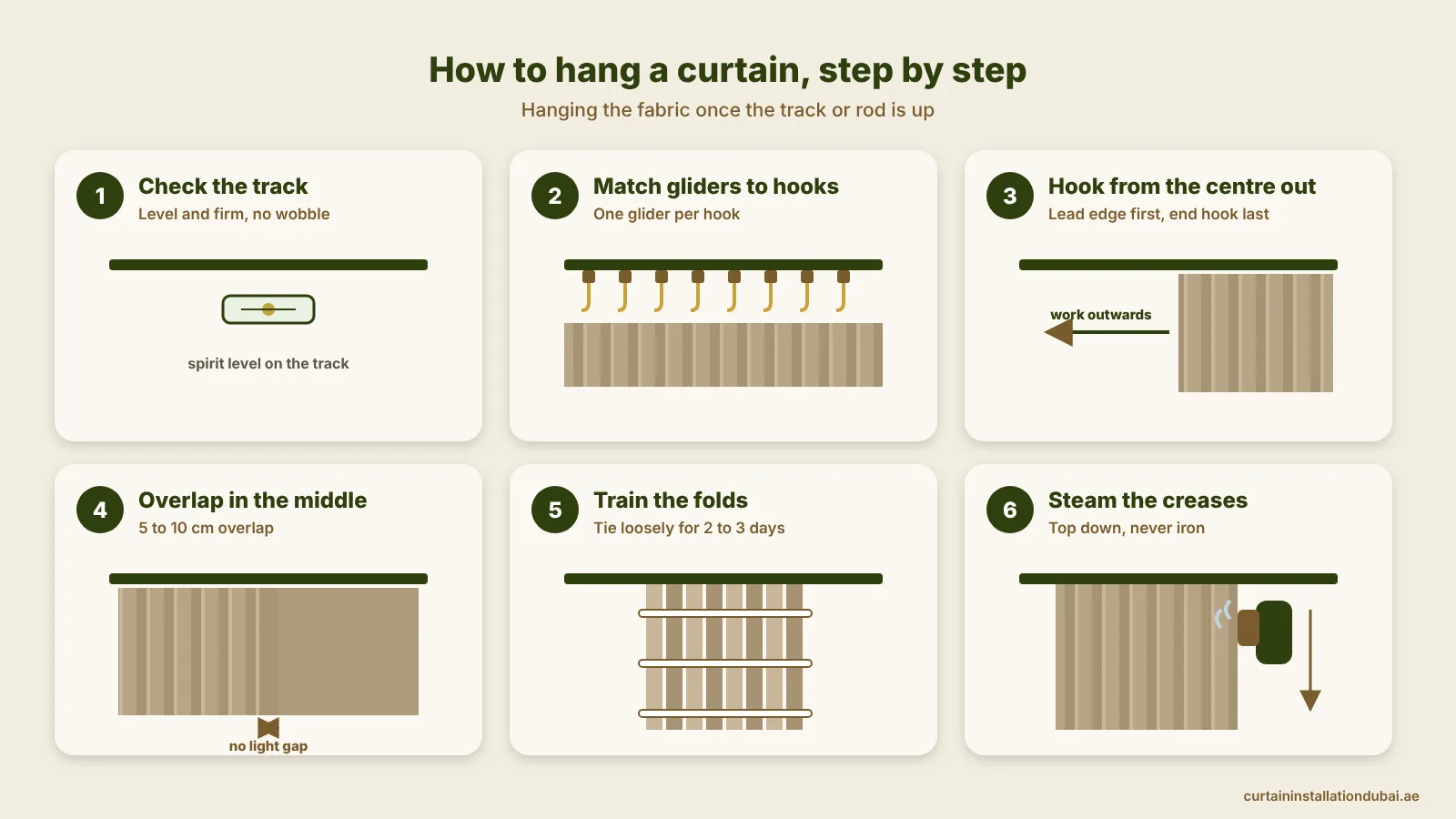
- Check the track or rod is level and firm. Put a spirit level on it and pull down gently at each bracket. A track that is 5 mm out over 3 m shows clearly once the curtain hangs, and a loose bracket only gets worse under the weight of the fabric.
- Match the gliders or rings to the hooks. Count the hooks on each panel, then make sure the track has the same number of gliders on each side of the centre. Too few, and the header sags between hooks. Too many, and the spare gliders block the curtain from opening fully. Slide any extras to the ends behind the end stop.
- Hook up from the centre out. Start with the leading edge, the hook nearest the middle of the window, on the master carrier or first glider. Then work outwards one hook at a time. The last hook goes into the end stop or the bracket return, so the curtain wraps neatly back to the wall.
- Overlap the panels in the middle. On a pair, one leading edge should pass about 5 to 10 cm over the other when closed. Most tracks have overlap arms on the master carriers for this. Without an overlap, light shows in a thin line down the centre every morning.
- Dress and train the folds. Open the curtain fully and set each fold by hand, in and out like an accordion. Tie the stack loosely in two or three places with soft fabric strips, not tight string. Leave it tied for 2 to 3 days, the same settling time as the hem check. After that, the folds fall into place on their own every time you open the curtain.
- Steam out the creases. Packing creases drop out faster with a handheld steamer, working from the top down. Never iron a blackout curtain while it hangs, and never iron the coated side at all, because heat can crack the backing.
Bracket spacing and support
A curtain that sags in the middle or pulls away from the ceiling after a few months almost always has too few fixings. The rules are simple:
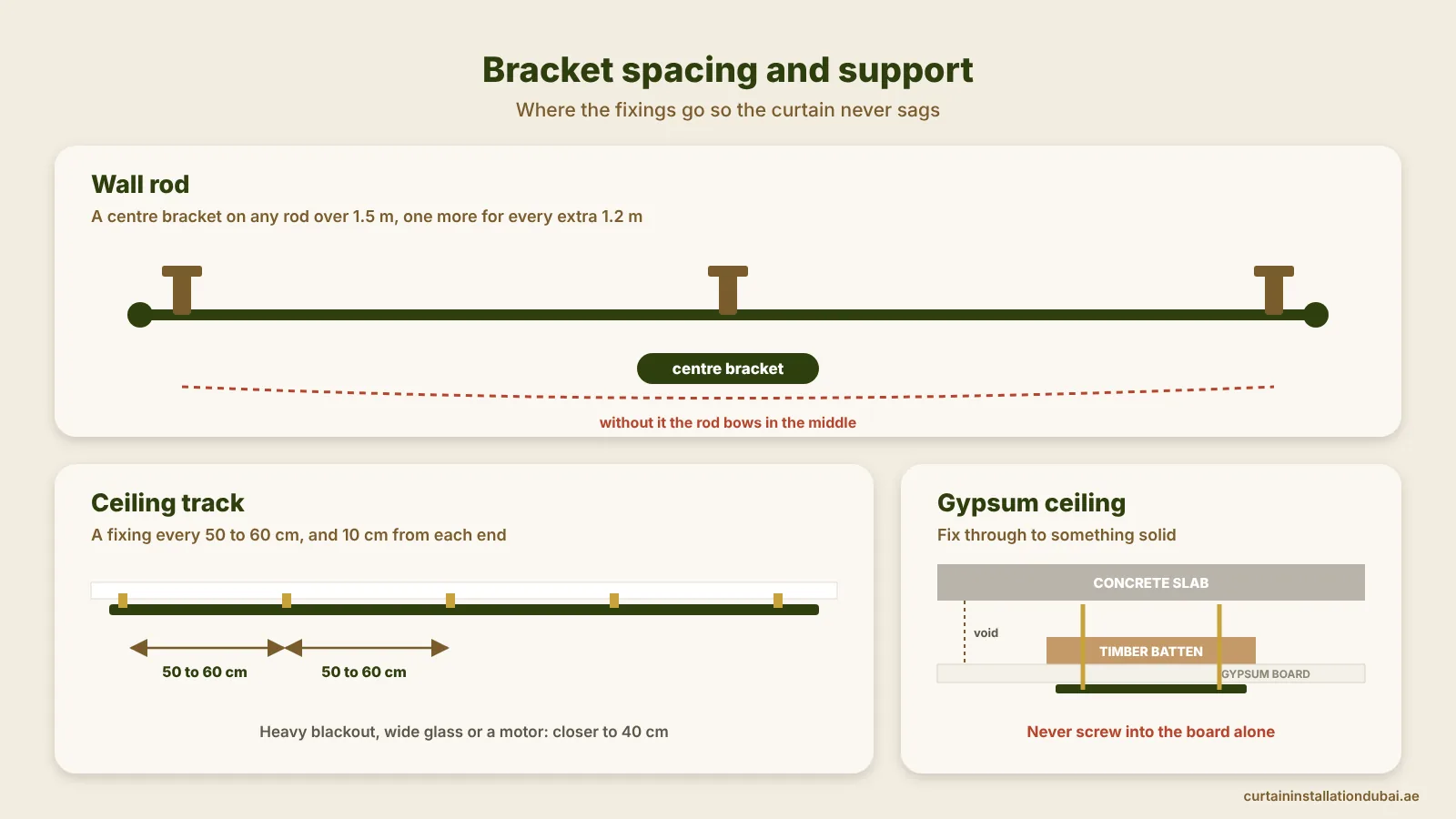
- Wall rods: a bracket at each end, plus a centre bracket on any rod longer than 1.5 m. Add another for every extra 1.2 m or so. Without it, the rod bows under the weight of a lined blackout within weeks.
- Ceiling tracks: a fixing every 50 to 60 cm, with the first and last about 10 cm from the ends. For heavy blackout, wide glass walls or a motorized track, go closer, to around 40 cm.
- Gypsum ceilings: never screw into the board alone. Gypsum holds a light sheer for a while, then cracks. The fixing has to reach something solid, either the concrete slab above with long anchors, or a timber batten fixed inside the ceiling when it was built. If you are not sure what is above the board, a stud or metal detector will tell you, or ask for the building’s fit-out drawings.
The drilling itself, the plugs and the anchors for different walls are covered in our guide on installing curtain rods. Our curtain rails and tracks page lists the tracks we fit and how much weight each one carries.
How to hang curtains in each room
The placement rules stay the same, but each room needs something slightly different from them.
| Room | How to hang them | Fabric | Why |
|---|---|---|---|
| Bedroom | Ceiling track, wall to wall, 1 cm off the floor, overlap in the middle | Blackout, often with a sheer behind | No edges for early light. See bedroom curtains |
| Living room | High and wide, double track | Sheer for the day, linen for the look | Soft light and a taller room |
| Kids’ room | Ceiling track or a firm rod with a centre bracket, no cords, no puddle | Blackout in a washable print, see kids curtains | Naps in daylight, nothing to pull down or trip on |
| Office or majlis | Ceiling track, one fabric and hem height across the whole room | Sheer in open areas, blackout in meeting rooms, see office curtains | Cuts screen glare and keeps the room looking even |
| Room on a busy road | Ceiling track, wall to wall, close to the glass | Our soundproof curtains | Every gap lets noise in, as well as light |
| Kitchen or bathroom | Short rod or track, sill length, inside the recess | Washable polyester sheer | Keeps fabric clear of the hob, sink and splashes |
If a room has more than one window, hang every curtain at the same height, even if the windows are different sizes. The FAQ below explains why.
Hanging two layers: which goes in front?
A double track gives you a sheer for the day and a blackout for the night. The question is which one sits next to the glass. Both work, and they give the room a different look.
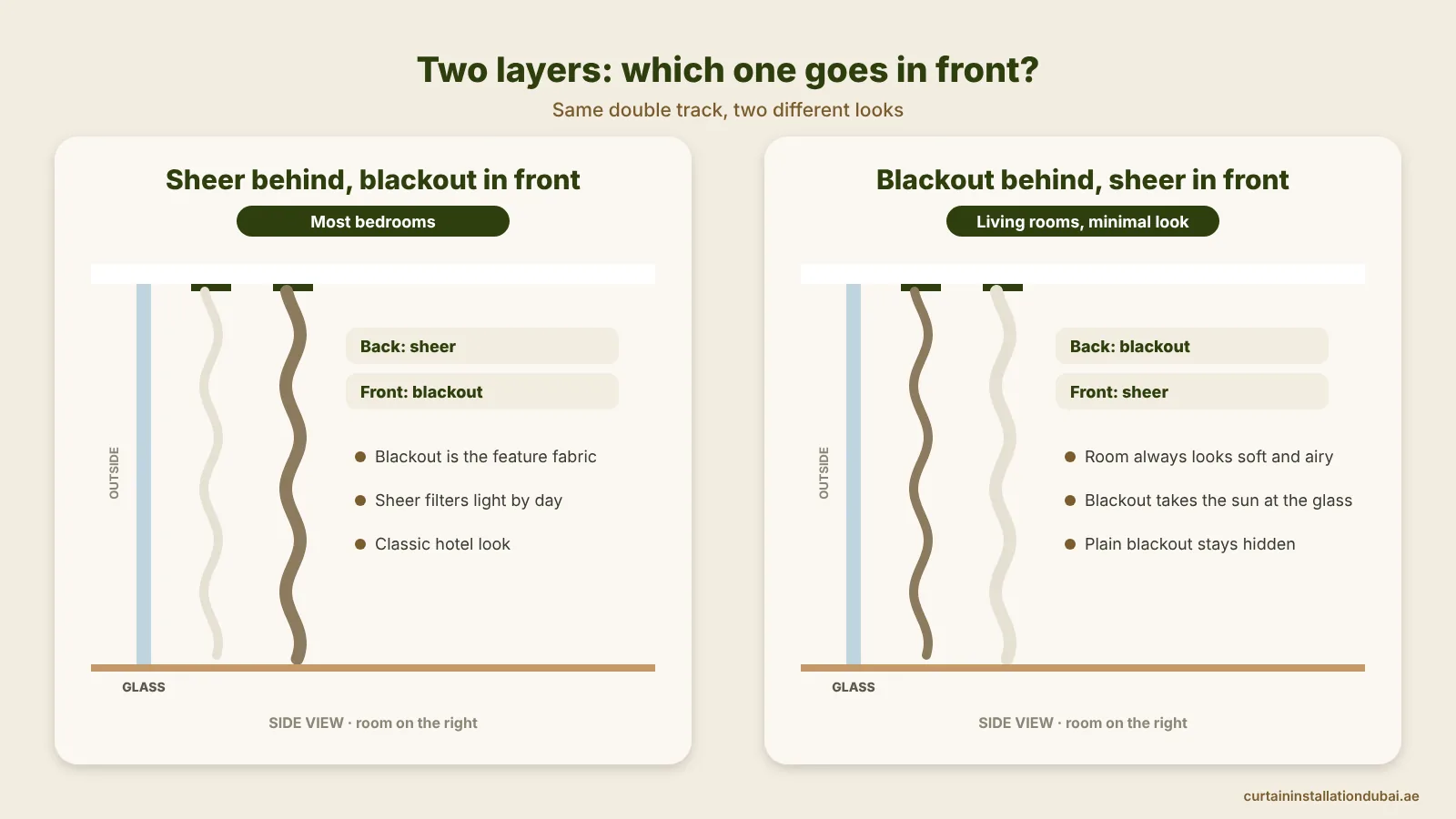
Sheer behind, blackout in front
This is the classic hotel setup and what we fit in most bedrooms. The sheer sits against the glass and stays closed during the day, filtering light and giving privacy. The blackout hangs on the room side, so it becomes the feature fabric. Pick a colour or texture you like, because you will see it every time it is open.
Choose it when: the blackout is the curtain you want to show off, or the room is mainly used at night.
Blackout behind, sheer in front
Here the blackout hides against the glass and the sheer faces the room. When the blackout is open, the window looks soft and airy. When it is closed at night, the sheer still covers it, so the room never looks heavy. The blackout also takes the full sun at the glass, which keeps more heat out and protects the face fabric from fading.
Choose it when: you want a light, minimal look in a living room, or the blackout is plain and you would rather not see it.
A few things that apply either way
- Both layers need their own track or channel, so each opens without dragging the other.
- Some Dubai towers ask for a white or neutral side to face the street, so every window looks the same from outside. Check your building rules before you choose a dark fabric for the layer next to the glass.
- If you plan to motorize, the layer you open every day is usually the one worth putting on the motor.
For more on layering two sheers instead of sheer and blackout, see double sheer curtains: benefits and how to layer them.
Common hanging problems and how to fix them
Already hung and something looks off? Find the problem in the left column.
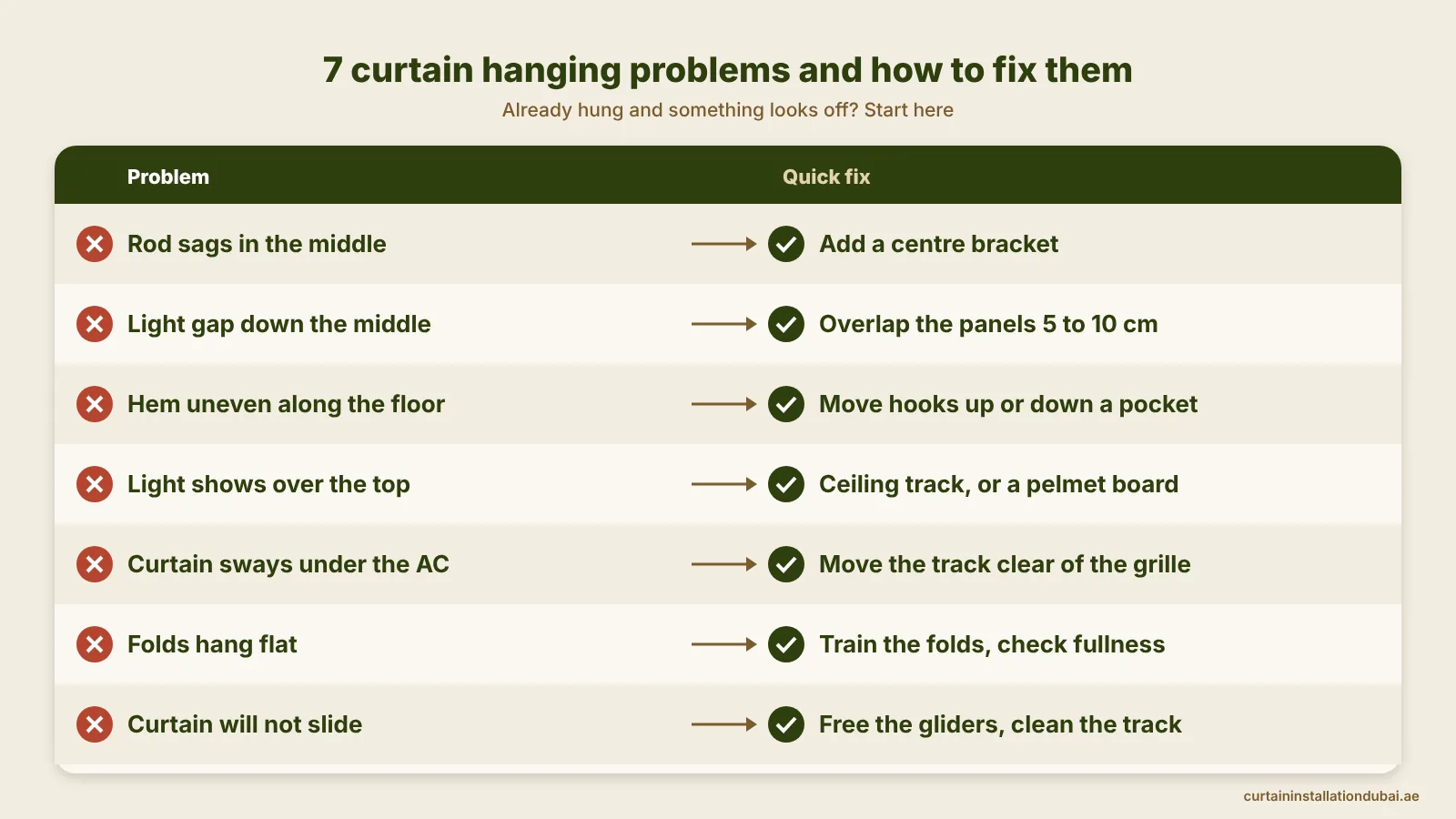
| Problem | Usual cause | Fix |
|---|---|---|
| Rod sags in the middle | No centre bracket | Add one. See bracket spacing |
| Light gap down the middle | Panels meet edge to edge | Overlap them 5 to 10 cm. See step 4 |
| Hem uneven along the floor | Sloping floor, or fabric still settling | Wait 48 hours, then move hooks. See the hem check |
| Light shows over the top | Wall rod with a gap above it | Move to a ceiling track. If you cannot, fit a pelmet board or return brackets that close the gap to the wall |
| Curtain sways when the AC is on | Track sits under or right next to the grille | Move the track 10 to 15 cm clear of the airflow, or angle the grille louvres away from the window. A weighted hem tape also calms light sheers |
| Folds hang flat or bunch | Not enough fabric, or folds never trained | Train them as in step 5. If they still look flat, the curtain is under 2x fullness, and only a wider curtain fixes it. See fullness |
| Curtain sticks or will not slide | Gliders on the wrong side of a joint, a bent track, dust, or too many gliders | Slide spare gliders behind the end stop, check the track joints line up, wipe the channel and add a little silicone spray. Never use oil, as it collects dust |
If the track itself is bent or too weak for the fabric, it needs replacing. See the options on our curtain rails and tracks page. If the curtain is the wrong length or width for the window, our curtain alteration service can re-hem, widen or re-pleat it. For light that still gets into a bedroom after all of this, our guide on hanging blackout curtains for a dark bedroom covers every gap.
Hang them yourself or get them fitted?
Hanging a curtain on an existing rod is a 10-minute job anyone can do. Fitting the track or rod is where it gets harder, and where the real cost sits.

What it really costs
Doing it yourself looks free, but a decent drill, a level, the right anchors and a ladder can easily cost more than having one window fitted. The first window usually takes 1 to 2 hours. The expensive part is getting it wrong: a cracked gypsum ceiling, a track 1 cm out of level that shows forever, or holes in a rented flat that come out of your deposit.
Getting it fitted: a single window is AED 99, and a window with sheer and blackout on two tracks starts from AED 150. The fitter fixes the hardware, hangs and levels the curtain, trains the folds and leaves you with a 1-year warranty on the work. A new track is extra if you need one. Fabric rates and full-room examples are in our curtain prices in Dubai guide.
When paying for fitting saves money
- Gypsum ceilings, where the fixing has to reach the slab or a batten
- Wide glass or heavy blackout, where a weak fixing fails within months
- Motorized tracks, which need the motor set up and the limits programmed
- Rented apartments, where clean, minimal holes protect your deposit
- Several windows at once, where a team finishes in an afternoon what takes you a weekend
If you already have a sound rod or track and just need the curtains hung, do it yourself with the steps above. For everything else, our team fits curtains across Dubai, often the same day. Message us on WhatsApp or book a curtain fitting.
Curtain hanging FAQs
Should all curtains in one room hang at the same height?
Yes. Even if the windows are different sizes, keep every track or rod at the same height and every hem at the same level. Matching lines make the room look planned. Curtains at different heights make the walls look uneven, even when each one is right for its own window.
Should the rod finish match the other hardware in the room?
It does not have to match exactly, but it should belong to the same family. Brushed brass rods sit well with brass handles and lamps, while black or matt nickel suits modern rooms with black frames. With a ceiling track the question disappears, because the track is hidden behind the curtain.
Can you hang curtains in front of a window that opens inwards?
Yes, but check that the window clears the curtain before you fit anything. Tilt-and-turn windows, common in Dubai villas, swing into the room. Fit the track high enough and far enough from the wall that the open sash does not hit the fabric, and make sure the curtain stacks clear of the handle.
Can a tension rod hold curtains?
Only light ones. A spring tension rod inside a recess works for a short kitchen or bathroom sheer. It will slip under a lined blackout or a long curtain, and it can mark the plaster as it slides. For anything floor-length, use a fixed rod or track.
Do I need permission to drill for curtains in a rented flat in Dubai?
Check your tenancy contract first. Most landlords accept curtain fixings, but some ask for approval or for the holes to be filled when you move out. Ceiling tracks into gypsum are easy to patch, and our fitters keep holes to the minimum the track needs.
How do I rehang curtains after cleaning?
Put the hooks back in the same pockets they came out of, so the hem stays level, then follow the same steps as a new curtain: hook from the centre out, dress the folds and tie them for a couple of days. If you use our curtain cleaning service, we take the curtains down, clean them and rehang them for you.
Related services and guides
Want them hung properly the first time?
Our team fits tracks, rods and curtains across Dubai from AED 99 per window, often the same day, with a 1-year warranty.